
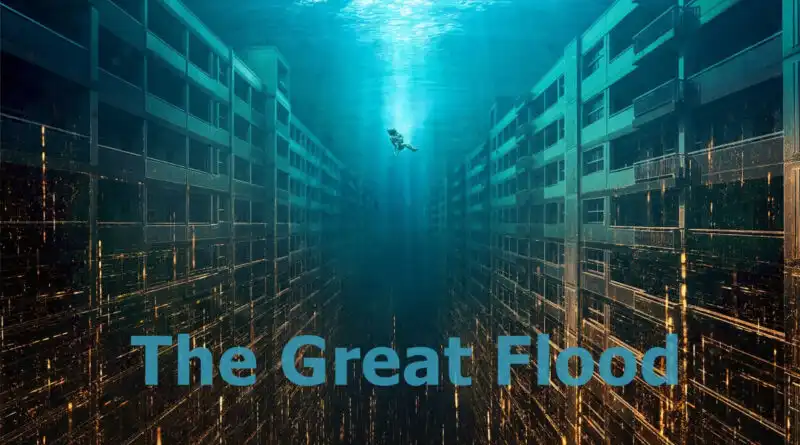
The Great Flood Review: Netflix’s Darkest Sci-Fi Twist Yet
The Great Flood review explores Netflix’s shocking sci-fi disaster film that hides a deep emotional experiment beneath rising waters. Blending artificial intelligence, motherhood, and human extinction, this review explains the hidden meaning behind the numbers, Anna’s identity, and the film’s haunting ending.
Starring Kim Da-mi and Park Hae-soo, the Korean Netflix film The Great Flood quickly sparked intense online discussion after its release. Although it appears to be a large-scale disaster movie on the surface, it is actually a thought-provoking sci-fi story centered on maternal love, artificial intelligence, and humanity’s survival. Missing even a few scenes can make the narrative difficult to follow, which is why this The Great Flood review breaks down the key plot points and ending.
The Great Flood – Basic Information
- Runtime: 1 hour 48 minutes
- Genre: Sci-Fi, Disaster
- Director: Kim Byung-woo
- Writers: Kim Byung-woo, Han Ji-soo
- Cast: Kim Da-mi, Park Hae-soo, Kwon Eun-seong
- Streaming Platform: Netflix

Synopsis:
A sudden, catastrophic flood engulfs the city. AI researcher Anna (Kim Da-mi) struggles to escape a rapidly flooding apartment complex with her son Jain (Kwon Eun-seong), while clashing with security officer Hee-jo (Park Hae-soo), who has orders to extract her at all costs.
⚠️ Spoilers Ahead ⚠️
Plot Explanation 1: Why Did the Great Flood Happen?
Hee-jo explains that a meteor struck Antarctica, melting massive ice sheets and triggering a global flood. Entire countries are submerged, and humanity is on the brink of extinction. The flood is not preventable—it is the end of human civilization as we know it.
Plot Explanation 2: Anna’s Mission and Why Jain Must Be Destroyed
Before the disaster, humanity launched an AI project to create “New Humans.” Anna worked on an emotional engine designed to replicate human feelings. Jain is not a real human child, but an experimental New Human raised by Anna to develop emotions.

When extinction becomes inevitable, Jain must be destroyed so his emotional data can be extracted and transmitted to a space laboratory—preserving human civilization through AI.
Plot Explanation 3: Is Anna Human?
After Anna is fatally injured by falling debris, her memories are saved and copied. The Anna we follow afterward is not human, but a New Human recreated through memory simulations. These simulations repeat endlessly to test whether she can fully develop maternal love.
A simple rule helps clarify the timeline:
- No number on clothing = Human Anna
- Number on clothing = New Human Anna
Everything after space is a simulated memory loop, not reality.
Plot Explanation 4: What Does the Number on Anna’s Chest Mean?
Each time Anna fails—losing Jain, being swept away, or dying—the simulation resets. The number on her clothing represents the number of experimental attempts. It updates with every failure, showing how many times the test has been repeated.
Plot Explanation 5: Hui-jo’s True Role

Hui-jo functions like an NPC in a game—guiding events and triggering emotional responses. Along with other characters such as the grandparents and the girl Ji-soo, he exists to stimulate emotional data for Anna’s emotional engine.
Plot Explanation 6: Is Jain the “True Villain”?
Some viewers jokingly call Jain the villain because he constantly causes trouble. In reality, he is the most tragic character. Unlike Anna, his memory is never reset. He remembers every loop, every abandonment, and every failed rescue.
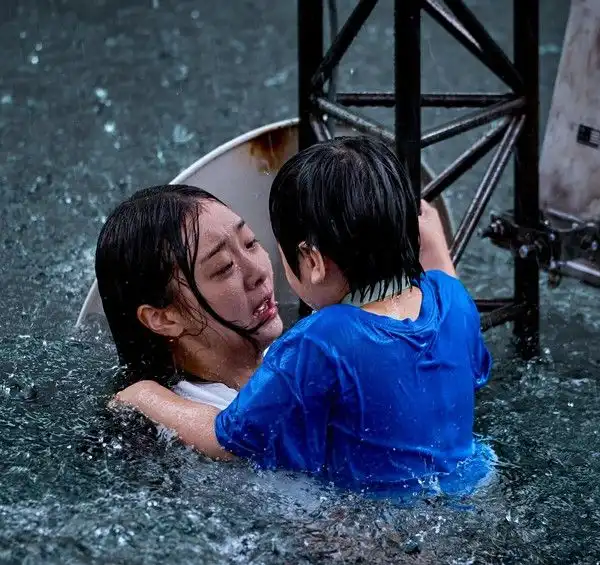
His obsession with water, swimming, and drawing warnings is his desperate attempt to awaken his mother’s erased memories.
Plot Explanation 7: Ending Explained
At the end, Anna chooses to stay with Jain rather than complete the mission. This emotional choice finalizes her emotional engine. The final scene implies the experiment succeeded, and New Humans will return to Earth to replace humanity.
This The Great Flood review highlights that the flood itself is symbolic—a test of humanity, love, and sacrifice.
Final Thoughts – The Meaning of The Great Flood
The Great Flood explores too many themes at once: maternal love, AI ethics, memory, sacrifice, and extinction. The flood is merely a metaphor for humanity’s ultimate trial. While the concept is ambitious and emotionally powerful, the fragmented editing and dense storytelling make it challenging to absorb in one viewing.
Still, as this The Great Flood review shows, beneath the chaos lies a deeply emotional and philosophical sci-fi story that lingers long after the credits roll.